
Mon Jan 27 2025 22:45:00 GMT-0800 (Pacific Standard Time)
tags: linux zine pdf imposition gimp
I recently hacked up some tools and a process for using Gimp to make and print a zine as part of a (currently unreleased) project.
I documented the process over here, and have the script for doing the imposition available for download. Getting things set up initially was a little confusing and involved quite a fair amount of searching, trying, failing, and iterating...but now that things are mostly working, hopefully others can benefit from this work.
I enjoyed the process tho, and hope to save some effort when I revisit this again in the future.
And yeah, maybe Gimp isn't the best tool for this kind of thing. What's good for doing multi-page layout and imposition on Linux? Probably nothing?
Sun Jun 02 2024 21:16:02 GMT-0700 (Pacific Daylight Time)
It's easy to forget that the first week of June is still squarely in the springtime, not yet summer. As we became increasingly drenched today at a nearby campsite, I was reminded of this fact. The Pacific Northwest won't let you forget.
I didn't bring recording gear, so I just made this field recording with a cellphone, laying on a table, under a pop-up shelter while quietly reading a book.
Tue Jan 23 2024 16:59:42 GMT-0800 (Pacific Standard Time)

I started a ridiculous project like 9 years ago: To cut up the entirety of Michael Jackson's "Thriller" album into just the grunts and hoots, similar to what I did with Billy Idol all the way back in 2009.
This last weekend I found the project and realized just how close it was to completion, so I went ahead and finished it and published it.
So now I present to you: Thrilling Grunts. Enjoy.
Sun Dec 03 2023 19:10:00 GMT-0800 (Pacific Standard Time)
Introducing noise-arch radio. It's a thing I created.
It's a long-form audio stream of the items in the noise-arch cassette archive collection on archive.org.
Not everything in the collection is great, and some of it is obnoxious, but there are some real treasures in there as well! I find it fun to randomly "tune" in now and again to hear what's playing.
I calculated the total runtime from the metadata in the collection -- it's just over 2 weeks. In other words, the playlist will get re-shuffled about every 14 days. It's a lot of content.
I have no idea how many listeners it can support on such a small cloud instance, and I have given zero thought about scaling it. I assume nobody cares or actually wants to listen to this stuff, so whatever.
Wed Feb 22 2023 20:54:20 GMT-0800 (Pacific Standard Time)
tags: pdx snow weather volunteering
These photos were taken about 3.5 hours and 10 miles apart:
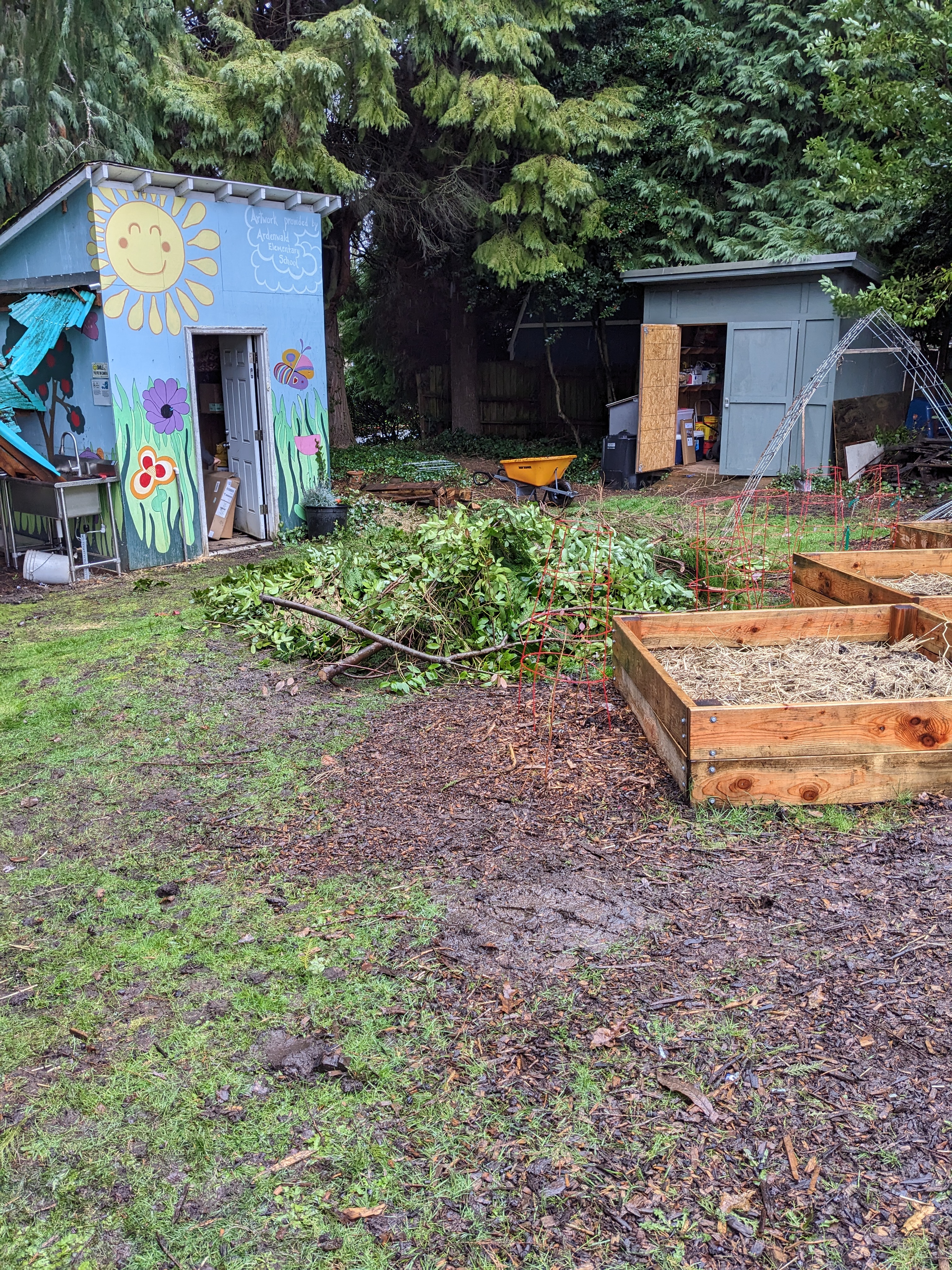
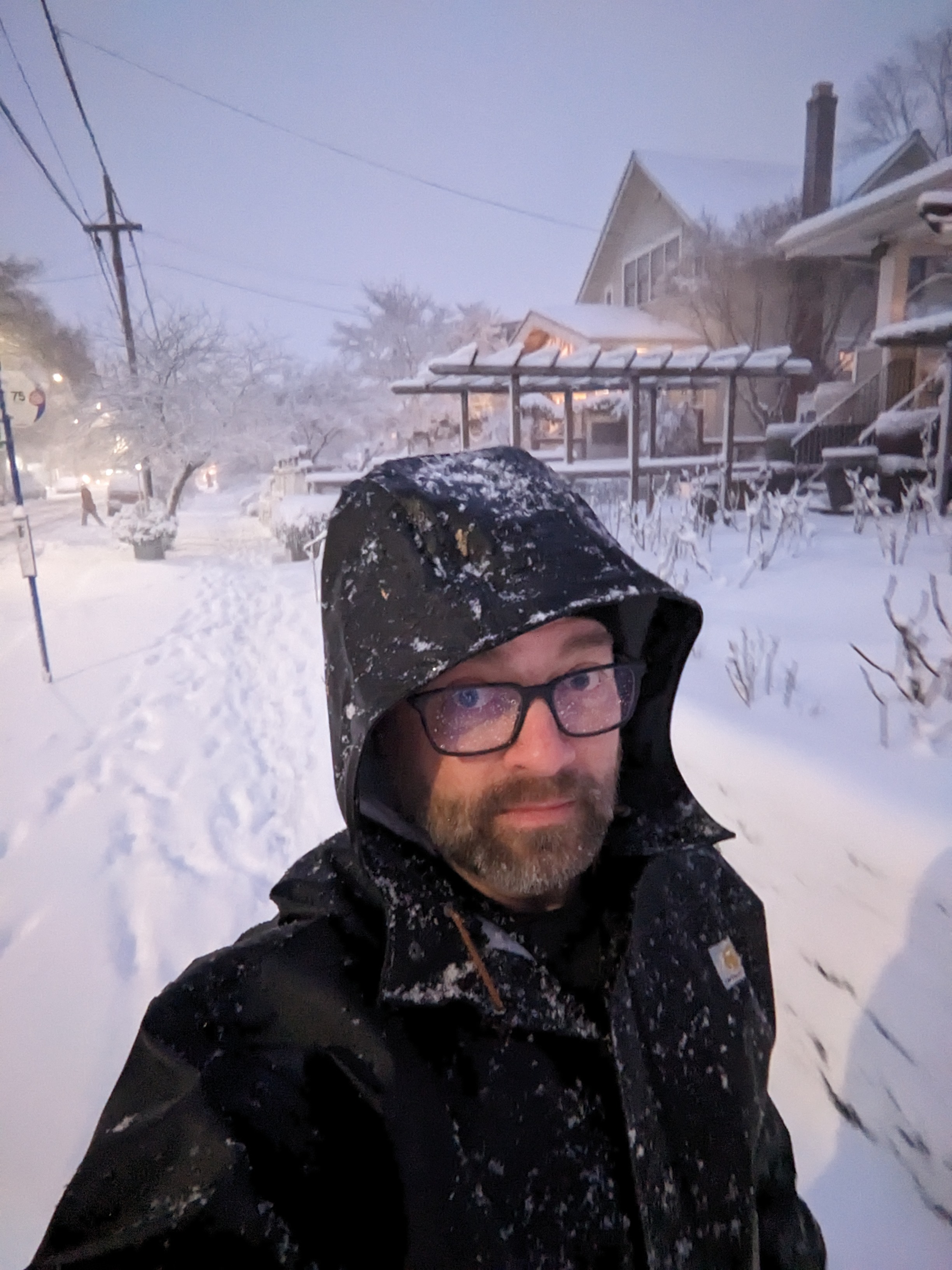
Weather changes pretty quickly in PDX! We were still cold while volunteering at the community garden down in Milwaukie today, but it wasn't snowy. The drive home took much, much longer than it ever should have...but now we have a TON of snow.
Wed Feb 22 2023 20:54:20 GMT-0800 (Pacific Standard Time)
tags: video vimeo archive deathoftheinternet
Many years ago now (a lifetime in internet years), this really fun, accessible, site called Vimeo sprung up, allowing creative folks to post video content. It was kinda like YouTube, before Google really made YouTube into whatever the hell it is now. Vimeo had a lot of polished, intentionally artful content, and it also seemed to be friendly to makers and hackers and stuff. I dunno. Apparently it struggled to find itself, to find its niche or place of sustainability in the world of fledgling video streaming sites. Back when sites didn't have to be services. Back before everything was trying to demand subscriptions for bemusing, mundane or purely educational content.
Anyway, it seems that Vimeo has probably been on its last leg for several years now, presumably sold off and passed along to whoever is trying to save it from itself. To maximize profits over people. Same shit. Different company.
These things happen. One "important" expensive person makes a "tough decision" and then entire communities of content disappear, sometimes overnight.
I don't know what has or will happen with Vimeo per se, but it seems to be on the way out and I don't wanna stick around to find out. In fact, I haven't for years.
So I pulled my old content down and have it archived here in a personal vimeo archive now. It's not that big, hosting it should be fine.
Tue Feb 21 2023 22:29:13 GMT-0800 (Pacific Standard Time)
tags: noise audio piezo microphones
Finally starting a process of building a small collection of ACTUALLY USABLE diy contact microphones.
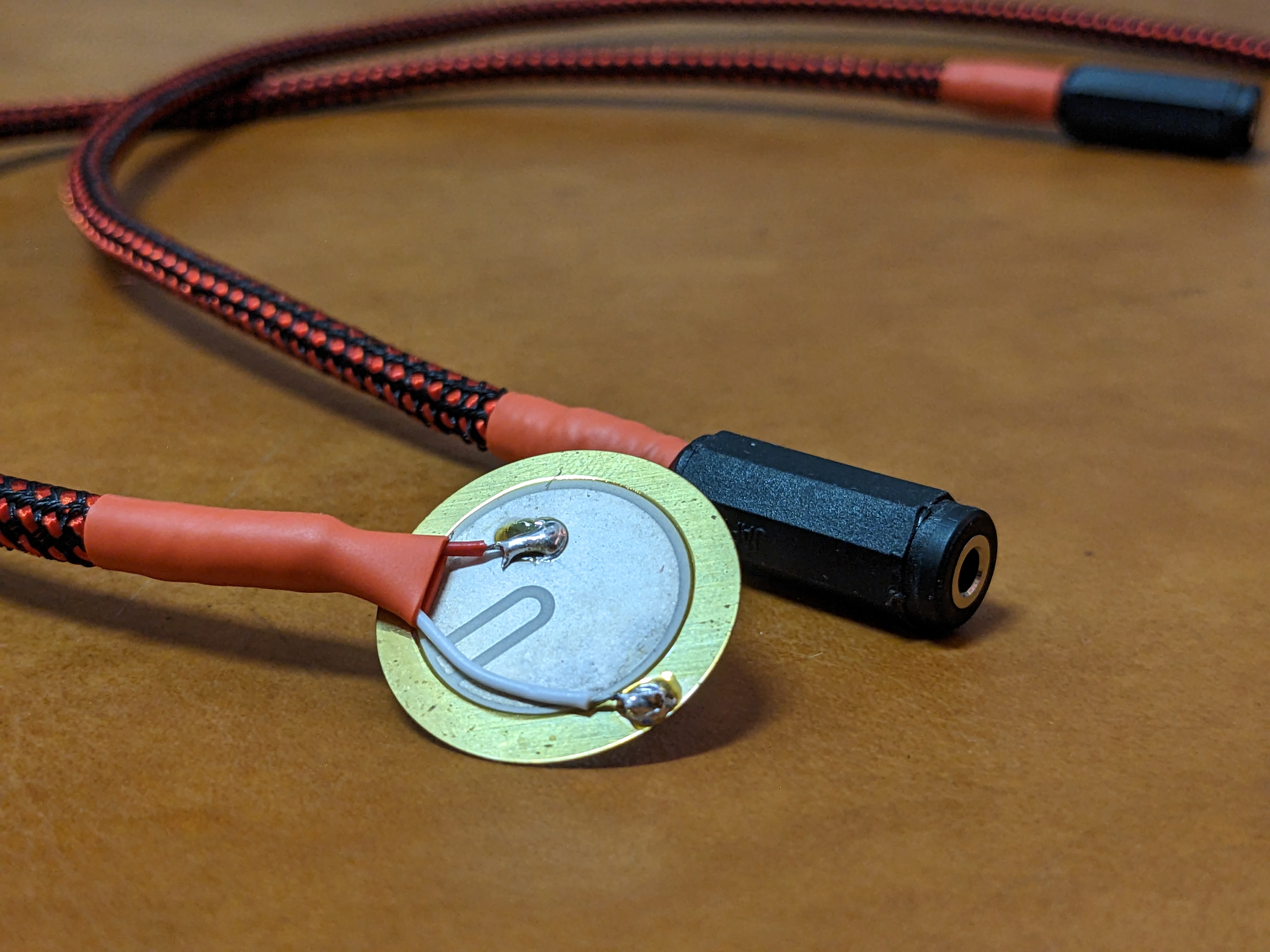
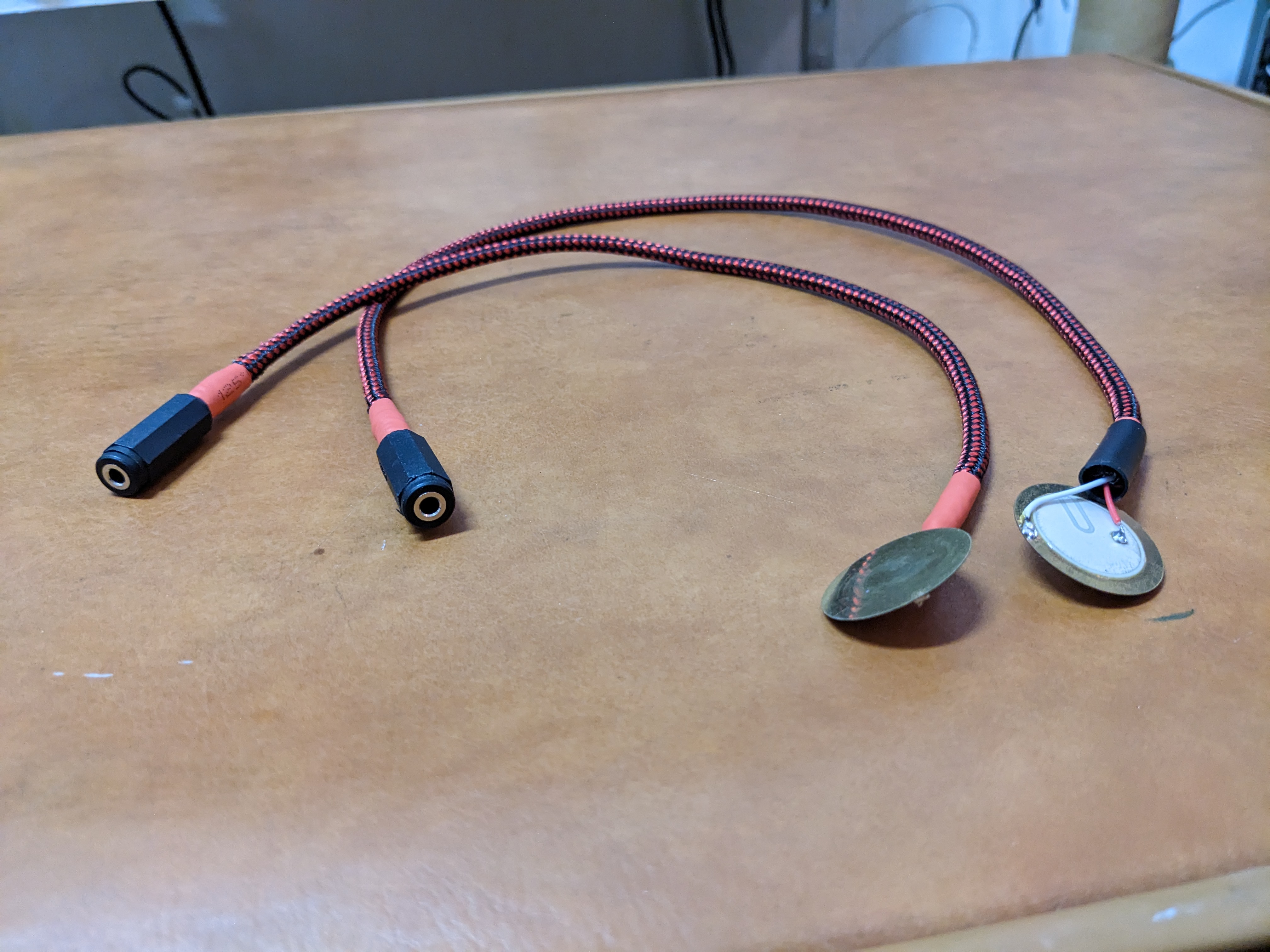
The ones pictured here will have some strain relief before being plasti-dipped.
I've built these over the years, but never of any decent quality. In fact, I think the one I made
back in 2005 when I made the
Liar's Rail recording just had some exposed
solid-conductor twisted pair wire hanging off it (recycled phone cord or ethernet I think).
So any time in the last couple of years that I've reached for one in the parts bin it seems to always be screwed up and doesn't work right. That frustration plus a small surplus of discs remaining from Wacky Willy's days provoked this process.
It's purely an aesthetic choice, but I now totally love cables with nylon sleeves over them now. This is my first time actually hacking/reusing some cable like that. I think maybe the right thing to do is to buy the sleeving separately, but I got lazy and hurried into buying a longer prefab cable for reuse. It's fine and totally workable, but some cable does get wasted due to fraying. If you look carefully in the photo above, one of the mics has a larger black piece of heat shrink covering some area where the sleeve didn't stretch as much as I had expected. I think it won't matter much once it's dipped, but there's a learning process here for me.
Tonight was also my first attempt at recording directly from the contact mics with the Zoom H2n. The default mic power was enabled, and the sound was very clear and loud. Stoked it worked so well.
I intend to also build some other formats, like:
Sat Dec 31 2022 22:59:00 GMT-0800 (Pacific Standard Time)
I don't normally like to do the whole "End of Year" review that everyone does, but given the pandemic, I've reflected back on 2022 and realized that, compared to the prior two years, it was quite a busy and exciting time.
So why the hell not. Let's do this.....what did I get up to? AKA "better late than never" AKA "here are all the things I didn't blog about during the year"...
Well, the new year started off with a continuation of the virtual biweekly (and sometimes weekly) Cult Movie Night I've been hosting online with a handful of friends. This became a tradition in the middle of 2020 during the wild times of early covid. The process involves me selecting some gory or bonkers underground psychotronic film to watch, transcoding it, and then spinning up an ephemeral cloud instance for a few hours in order to run Owncast, a self-hosting video streaming service. The centralized streaming allows us to do a coordinated screening without having to distribute files to folks in advance or to synchronize playback.
I've also continued collecting cult movie trailers that I play before the movie starts. I've gathered more than 380 trailers now. If played back to back, it would be more than 12.5 hours!
I learned about the existence of some awesome online classes with Atlas Obscura and found one called "Composing Experimental Music (with Jaime Stewart of Xiu Xiu)". I've been a fan of Xiu Xiu for more than a decade, so this seemed really interesting. From the course outline, I wasn't 100% sure how much of the techniques/materials would be new to me, but I liked the idea of using a class to provide a regular cadence for creative sessions and deadlines for doing homework as motivator.
And it worked! I made several recordings and blogged about the process back in February. It was really pretty fantastic and I enjoyed it. My intention to assemble some of the work into an official Infiltration Lab release did not happen, though. Oh well.
Check out the blogs here for more details and delicious sounds: 1, 2, 3, 4
In the middle of February I dragged a dozen friends out into the cold to ride around on bicycles and celebrate my birthday. Coincidentally, this was also the end of the Portland Winter Light Festival and our route took us to a bunch of different public light-based art installations.
This was also the final days of the 2022 Midnight Bicycle League challenge, which is a fun/relaxed challenge related to riding bicycles at night during the winter.
Here is a photo of me before the ride, and a drawing I submitted in my journal for the MBL:
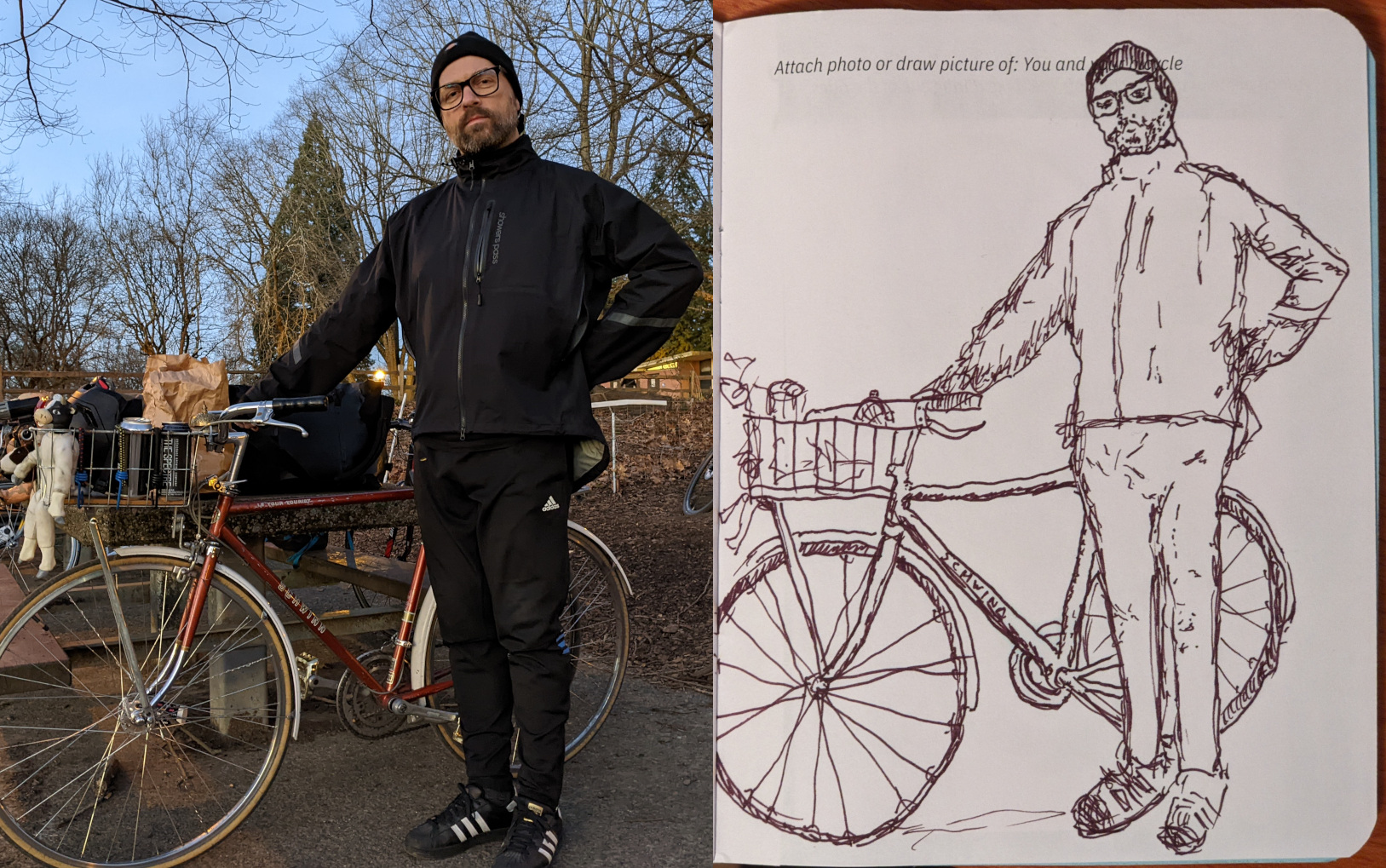
This was the most fun I've had on my birthday in a VERY long time!
Walla Walla is a real place, but I had never visited. I discovered that Vicki Bennett/People Like Us (a cut-up/sound/video/multimedia mashup artist whose work I appreciate) was doing a solo show and weekend of events in early March at Whitman College in Walla Walla, WA. After a couple of years of being cooped up at home, not traveling, not doing things, I decided to say fuck it and decided to go on my own. As much as I love my people, it was nice to not coordinate plans and to just escape with myself for a while.
The weekend was awesome! On the artistic front, there was a screening of Nothing Can Turn Into A Void, a documentary about Vicki Bennett's work followed by a Q&A session with Wobbly. The following day was a screening of "The Mirror" and a live performance by Negativland with Sue-C doing live visuals. And on the last night was a live broadcast on the college radio station. All of these were super friendly, accessible, and had a right-sized kinda college art program feel. Loved it!
The gallery show was a force of nature. In a small space, it gave the viewer a glimpse into the depths of Vicki's collection and exposed some of her creative process. In addition to the physical printed paper MIND MAPS were a couple (few?) screening rooms showing a selection of her films, some with headphones, some without. Sometimes the audio bleeding between screens was just amazing. There was also a very nicely done larger wide-format installation (and I think edited excerpt?) of "The Mirror".
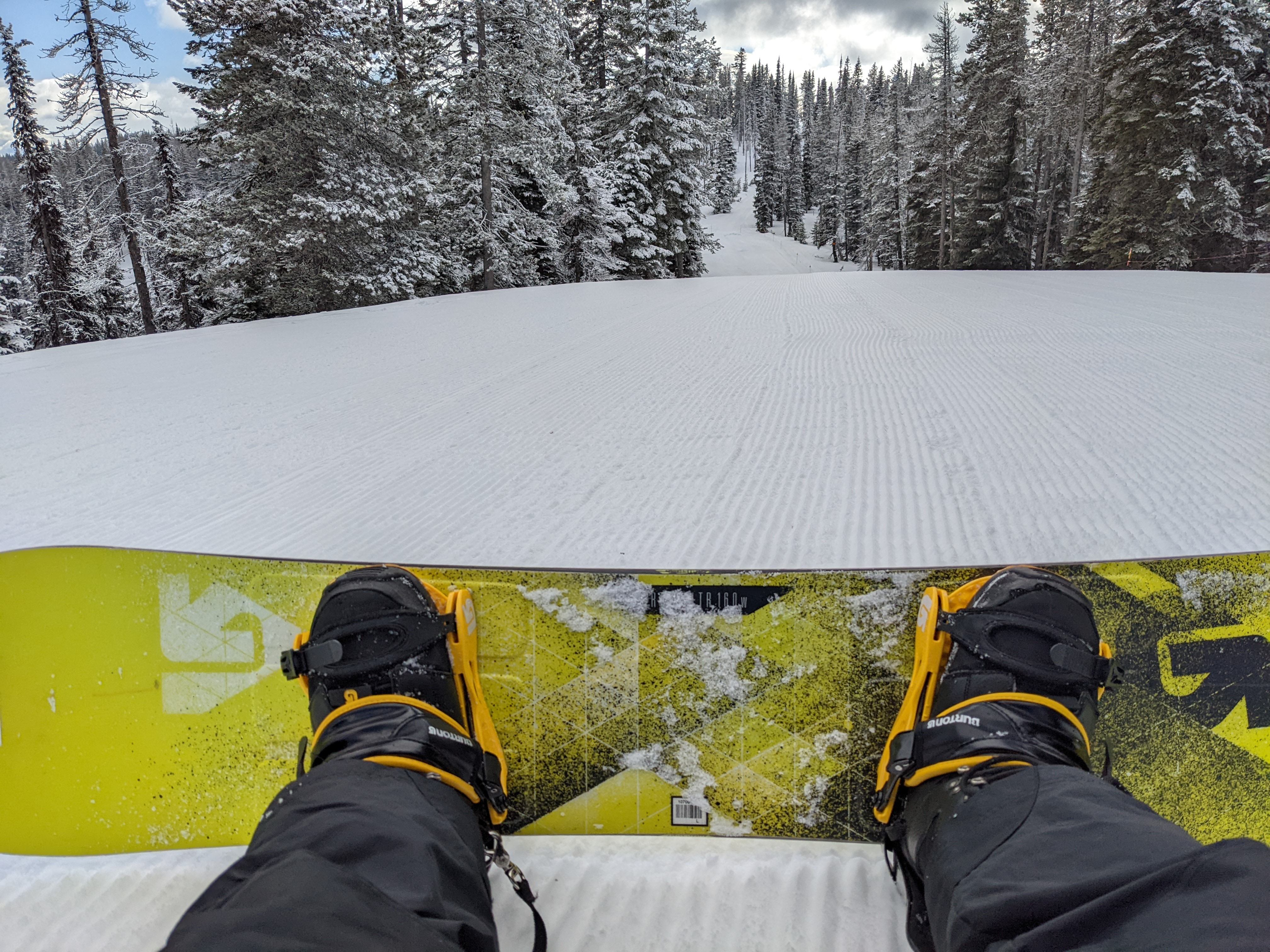 I also used the opportunity of being in Eastern WA to go snowboarding at Blue Mountain,
a short drive from Walla Walla. It was my first time on a snowboard in about 15 years,
and I managed not to die nor get too banged up. It was also my first time snowboarding
with a helmet. :) The conditions were damn near perfect, I got there right as they
opened, and because it was a random weekday it was not crowded all morning (and I never
waited for the lift). After 6 or 7 runs, I was pretty exhausted and wrapped it up not
long after lunch. But look at this freshly groomed run:
I also used the opportunity of being in Eastern WA to go snowboarding at Blue Mountain,
a short drive from Walla Walla. It was my first time on a snowboard in about 15 years,
and I managed not to die nor get too banged up. It was also my first time snowboarding
with a helmet. :) The conditions were damn near perfect, I got there right as they
opened, and because it was a random weekday it was not crowded all morning (and I never
waited for the lift). After 6 or 7 runs, I was pretty exhausted and wrapped it up not
long after lunch. But look at this freshly groomed run:
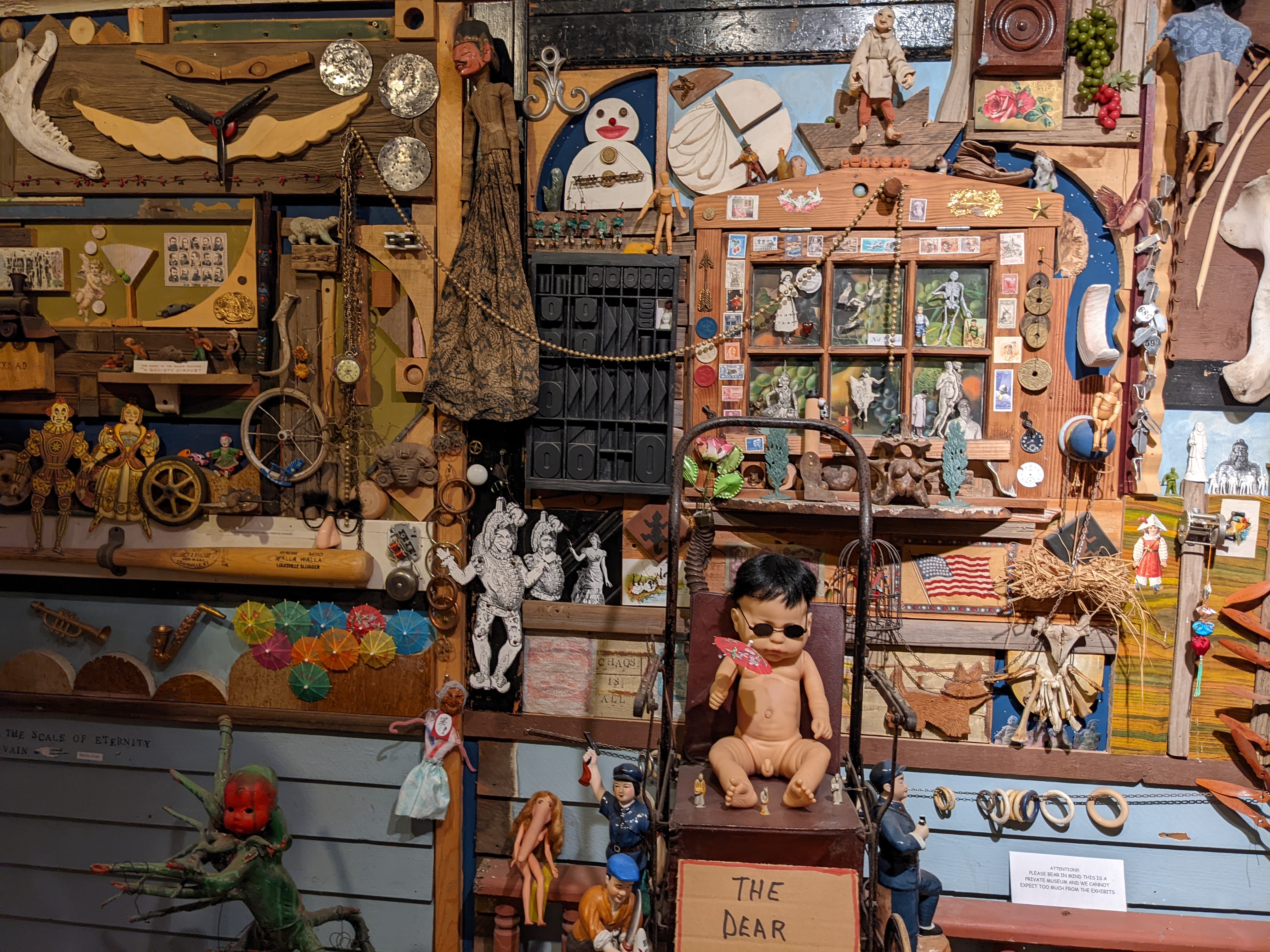 While in Walla Walla, I also made a point of visiting the
Museum of Unnatural History,
a dadaist/surrealist one-man gallery of oddities and strange peculiarities.
I was in awe at the scale and density of the place, and I have an affinity to
Dadaism. This spot felt a lot like the 24 Hour Church of Elvis, but with more
"wow look at how this has been cultvated over 50(?) years"!
While in Walla Walla, I also made a point of visiting the
Museum of Unnatural History,
a dadaist/surrealist one-man gallery of oddities and strange peculiarities.
I was in awe at the scale and density of the place, and I have an affinity to
Dadaism. This spot felt a lot like the 24 Hour Church of Elvis, but with more
"wow look at how this has been cultvated over 50(?) years"!
The very elderly owner was nice (not as grumpy/playful as some visitors had previously reported), and he chatted with me for quite a while while I browsed around, and at one point asked if I liked the gallery enough to buy it. He said that he'd been trying to find some person/group to continue it because he's too old, but was frequently hitting friction due to the sexual and racial content (exploitation) in more than just a few of the works. No shit.
Apparently the museum is now permanently closed, which is a shame, and I'm fortunate to have visited while it was still around.
On the way back to Portland, on a beautiful day, I made a short stop along the Columbia river to hike up the Twin Sisters.
In the Spring, there were a variety of shenanigans...
After 10 years of tolerating the childlike teal color of my home office (came with the house), I finally decided to paint something of my own adult choosing. I was inspired by a video walkthru of Guillermo Del Toro's "Bleak House" and loved the wall color, so I straight up matched it. I love how it turned out and just how much more comfortable and warm this room seems now.
Sadly, my friend Chris died unexpectedly from heart problems. It was especially sad for me because even though I had met him for coffee a few months prior, we had plans to play some tabletop games a few weeks later. There was a nice military funeral at the national cemetary on Mt. Scott, and the only upside was that I was able to connect with some distant work friends from the FlightStats days. I miss you, Chris...you were one unique kind of weirdo, and we made some timeless memories.
 In April, I got to see Asuna perform "100 Keyboards"
at PICA. In this work, the artist has a large mandala style arrangement of 100 keyboards
that they turn on one at a time, each with one or two keys pressed with clips or sticks.
As you can imagine, the process is not rapid, and it takes time to build up all 100, during
which time the audience is able to explore the space and find interesting points of sonic
intersection. After all keyboards are finally sounding together, the process is reversed, and
one is sequentially turned off again. I enjoyed it tremendously!
In April, I got to see Asuna perform "100 Keyboards"
at PICA. In this work, the artist has a large mandala style arrangement of 100 keyboards
that they turn on one at a time, each with one or two keys pressed with clips or sticks.
As you can imagine, the process is not rapid, and it takes time to build up all 100, during
which time the audience is able to explore the space and find interesting points of sonic
intersection. After all keyboards are finally sounding together, the process is reversed, and
one is sequentially turned off again. I enjoyed it tremendously!
Also in April, I took a short trip to San Jose to meet with some of my work colleagues, none of whom I had yet met in person. This included the engineering director who hired me (based out of New Hampshire), and also my boss, who is based in Poland! It was nice to have some true IRL face-to-face time finally with colleagues from a highly distributed team. As far as cities go, San Jose mostly sucks and I wouldn't really recommend it unless work is involved. :) We made the most of it.
In May, I saw Frontline Assembly at the Hawthorne Theater with my friend Nick (Sun Tunnel). And then just a few days later I got to meet the legendary LLOYD KAUFMAN at Portland's historic Movie Madness. Mr. Kaufman signed my VHS copy of The Toxic Avenger and later that night we saw a screening of Shakespeare's Shitstorm at the badass Hollywood Theatre. Wow, that's a day not soon forgotten.
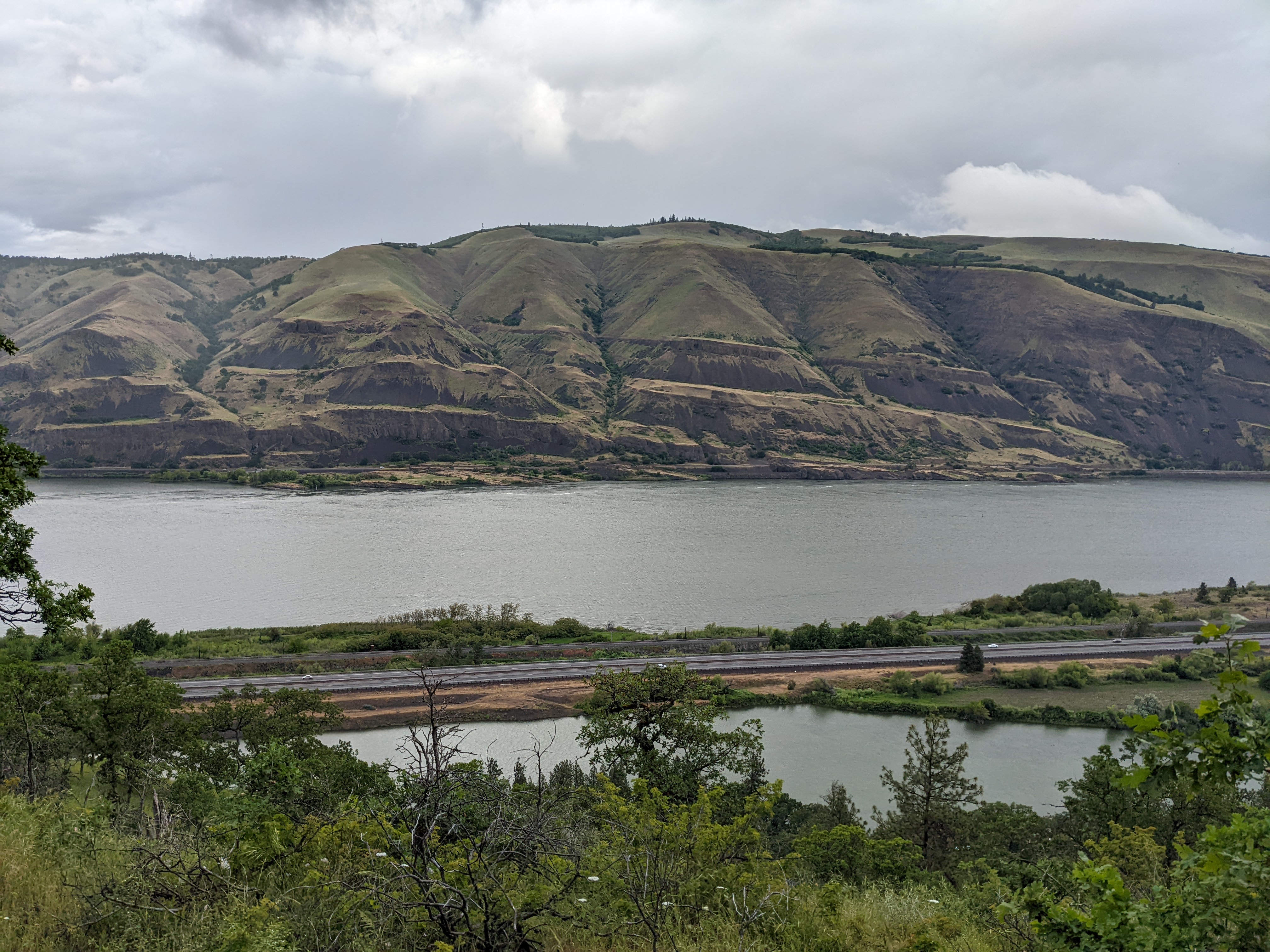 At the end of May we enjoyed a waterlogged camping/party adventure on my friend Chad's
property in Rowena along the Columbia River Gorge. The place is absolutely
beautiful and Chad and Andrea are unmatchable hosts.
We ended up only staying one night, but managed to catch up with friends we hadn't
seen much of since the pandemic started, and I stayed up all night. The tent got flooded,
the boy slept in the car, and I found out like 2.5 days later that I had a tick lodged
in my back. First tick bite for me that I know of, and actually kinda stressful thinking about
Lime disease...but Stacy removed it safely and I had a follow up with doctors who didn't
seem worried. For now. :-/ Maybe one day I'll morph into a superhero and get a friend named Arthur...
At the end of May we enjoyed a waterlogged camping/party adventure on my friend Chad's
property in Rowena along the Columbia River Gorge. The place is absolutely
beautiful and Chad and Andrea are unmatchable hosts.
We ended up only staying one night, but managed to catch up with friends we hadn't
seen much of since the pandemic started, and I stayed up all night. The tent got flooded,
the boy slept in the car, and I found out like 2.5 days later that I had a tick lodged
in my back. First tick bite for me that I know of, and actually kinda stressful thinking about
Lime disease...but Stacy removed it safely and I had a follow up with doctors who didn't
seem worried. For now. :-/ Maybe one day I'll morph into a superhero and get a friend named Arthur...
And then already June was here. Pedalpalooza got underway, I got to see America's funny man Neil Hamburger perform live, and I potted some spicy pepper plants: Serrano, jalapeno, birds eye, habanero, and ghost pepper.
I'm sometimes rolling around with a group of friends and work colleagues (nerds) on bicycles. We're loosely assembled into a goofy/fun/ragtag group of morons that rides bikes, with or without purpose, and we sweat it out and try to have beers after. Like other pandemic years, we also hung out a lot this year and did quite a few rides together.
Some memorable ones (and others not mentioned!):
The summer of 2022 was a fun and long one, filled with an extended dry/hot spell and finishing up with some smoke from forest fires (which has apparently started to become the norm). In spite of all that, we had a good time. Some highlights to follow:
The Monitorama conference was back in Portland in person this year, and I attended in early June. It's a great, single-track, grassroots conference centered around software observability and monitoring of software systems. It was my first in-person conference since the pandemic started, and even though all-day masking wasn't super fun, the conference was great and I made some new friends. My grandboss came to give a talk, and I reconnected with my friend MJ, who I worked with at Adidas. I also ran into my buddy Derek, who I worked with at the startup Qsent in the early 2000s, and I also met some OpenTelemetry folks in person. I was especially impressed at the skills of the in-person realtime sign language interpreters...it was amazing that they were able to keep up with the rapid-fire jargon.
Great conference, I highly recommend and look forward to going again (next year?).
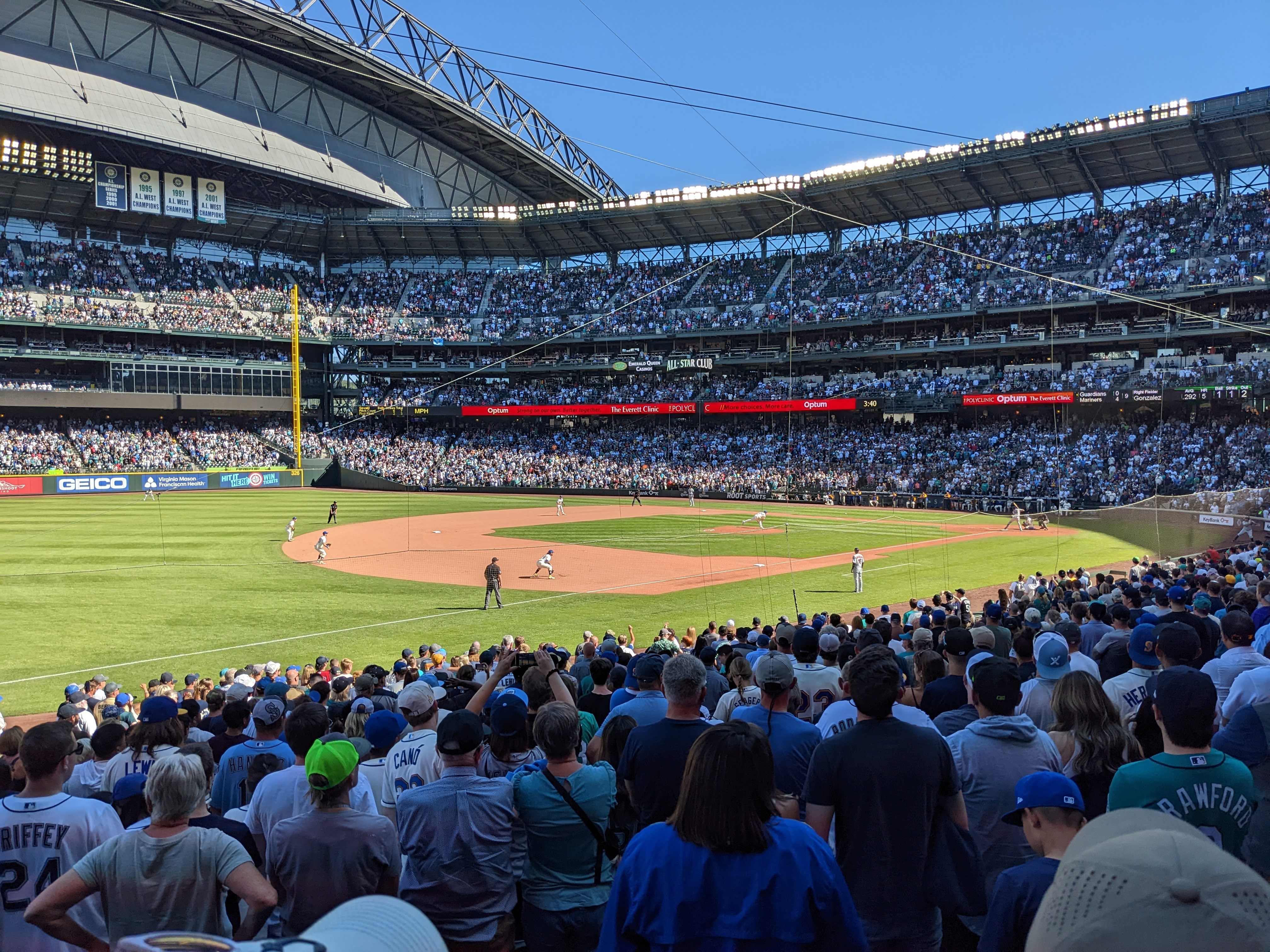 I took 2 trips to Seattle this summer. In late August, Elijah and I took
bikes on Amtrak and checked out two Mariners games in two days. When not at
the ballpark, we played pinball at Shortys and slept at
the classic Moore Hotel after heckling Hanson
fans coming out of the venue next door. We missed out on the Ichiro bobble
heads (not that we wanted to haul them around on bikes anyway!),
but we did manage to catch a bunch of the pregame commemoration
and got to hear him say some words, so that was pretty sweet.
I took 2 trips to Seattle this summer. In late August, Elijah and I took
bikes on Amtrak and checked out two Mariners games in two days. When not at
the ballpark, we played pinball at Shortys and slept at
the classic Moore Hotel after heckling Hanson
fans coming out of the venue next door. We missed out on the Ichiro bobble
heads (not that we wanted to haul them around on bikes anyway!),
but we did manage to catch a bunch of the pregame commemoration
and got to hear him say some words, so that was pretty sweet.
 For the second trip in September, I drove up
with my friend Alex and met up with friends Brian and Debbie to see
Portion Control
play at El Corazon. I thought the set was
good but was surprised that the turnout was so small for such legends.
Overall, I think we might have been a little underwhelmed, but the opening
band Chrome Corps. had some pretty
fun/odd energy with some solid industrial beats. Worth it. We got back
into town in time to see our friend Eric
play a synth set in a backyard.
For the second trip in September, I drove up
with my friend Alex and met up with friends Brian and Debbie to see
Portion Control
play at El Corazon. I thought the set was
good but was surprised that the turnout was so small for such legends.
Overall, I think we might have been a little underwhelmed, but the opening
band Chrome Corps. had some pretty
fun/odd energy with some solid industrial beats. Worth it. We got back
into town in time to see our friend Eric
play a synth set in a backyard.
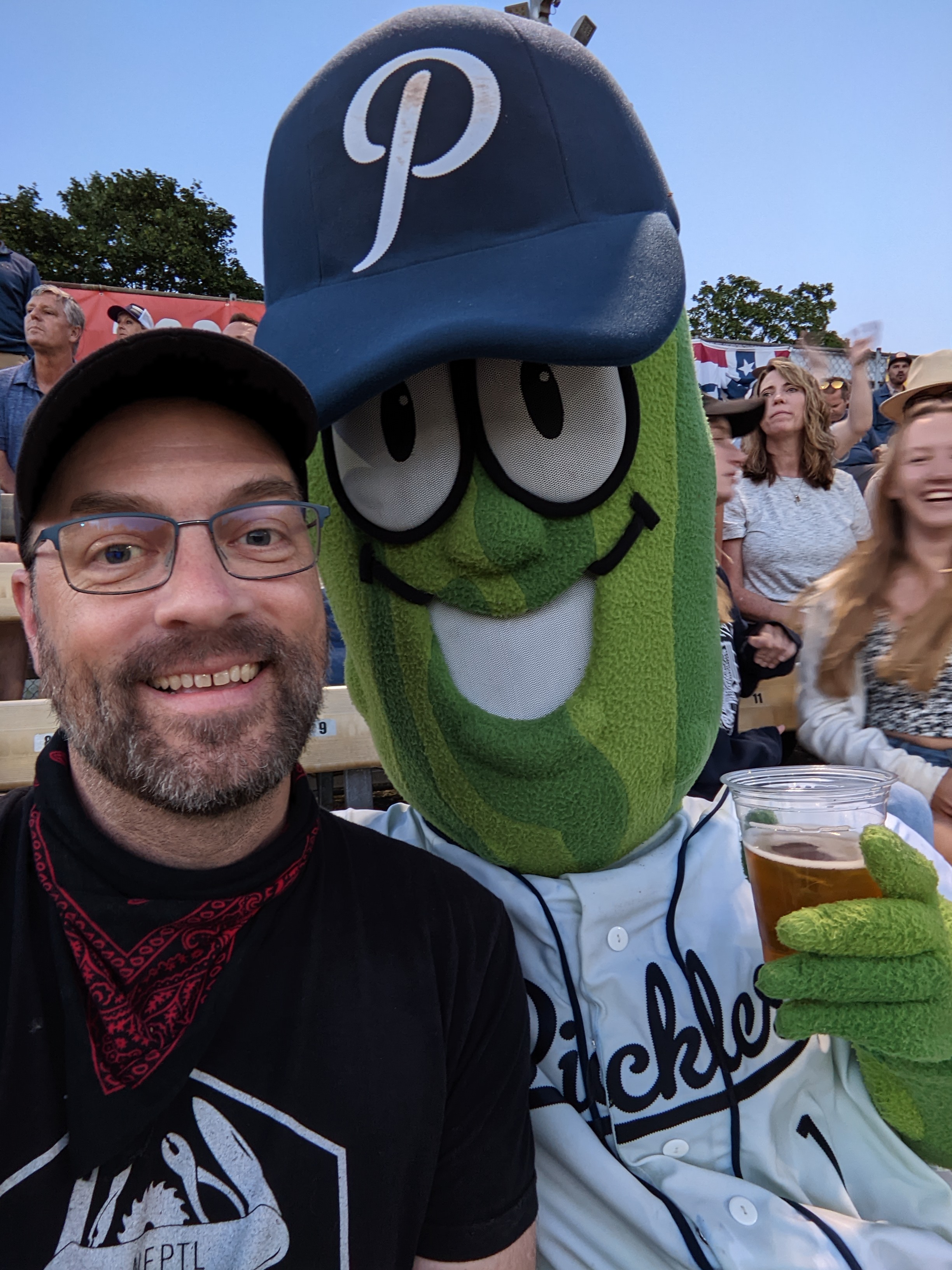 Sadly, Portland doesn't have a pro baseball team, but we do have our very own
Portland Pickles, a fun mostly
college-off-season team. I only managed to make it to one game this season,
but it's super fun and I want to try and go more next year!
Sadly, Portland doesn't have a pro baseball team, but we do have our very own
Portland Pickles, a fun mostly
college-off-season team. I only managed to make it to one game this season,
but it's super fun and I want to try and go more next year!
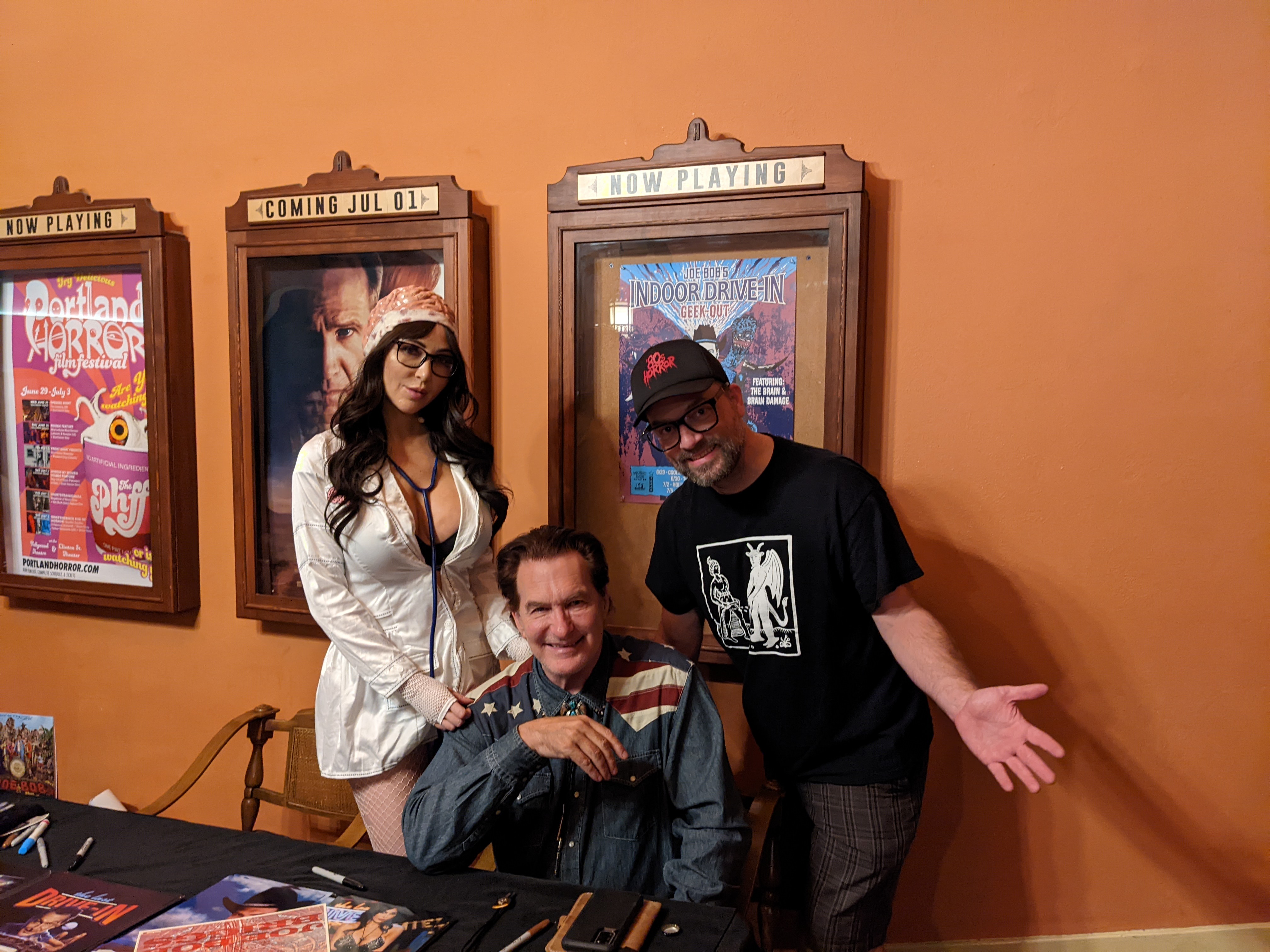 When I was growing up and discovering my love of horror/grindhouse/psychotronic
films, I spent a lot of time reading reviews from Joe Bob Briggs
in the local free papers and watching Joe Bob's Drive In Theater in the '80s and '90s. I was stoked to learn that Joe Bob
was doing a lecture and screening a double feature at The Hollywood Theater. This was the second time I had seen Joe Bob lecture at the
theater, but only the first time I got to actually meet him. After the screening, I scored an
autograph and Darcy ("the mailgirl") also signed it!
When I was growing up and discovering my love of horror/grindhouse/psychotronic
films, I spent a lot of time reading reviews from Joe Bob Briggs
in the local free papers and watching Joe Bob's Drive In Theater in the '80s and '90s. I was stoked to learn that Joe Bob
was doing a lecture and screening a double feature at The Hollywood Theater. This was the second time I had seen Joe Bob lecture at the
theater, but only the first time I got to actually meet him. After the screening, I scored an
autograph and Darcy ("the mailgirl") also signed it!
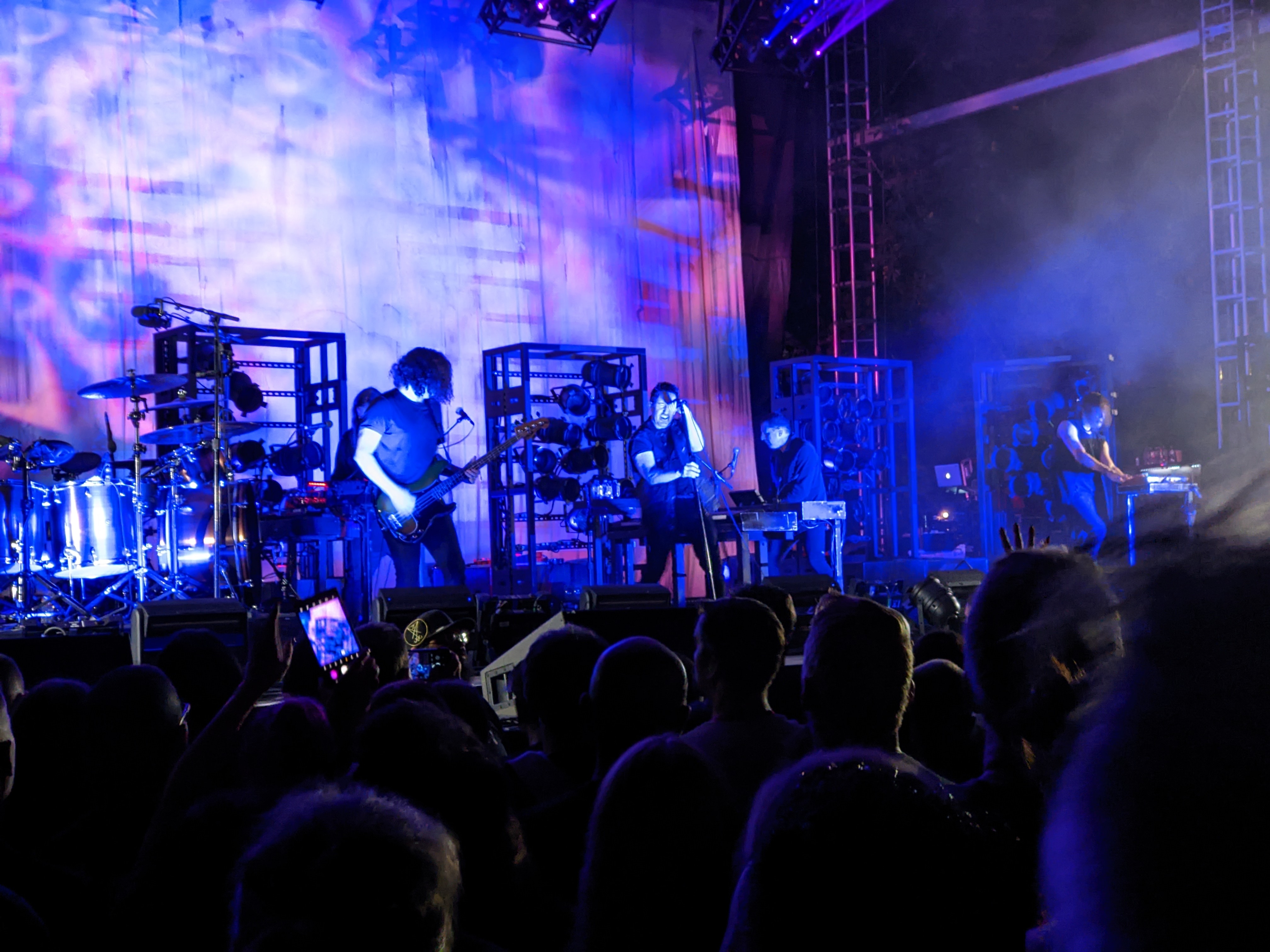 Some friends clued me into Nine Inch Nails playing at Edgefield, an outdoor venue
in Troutdale, OR, and Jared was so nice to buy me a spendy presale ticket! It was my 3rd time
seeing NIN (the first being 1991 Lollapalooza), and because so much time has passed I
was pretty excited but honestly had pretty low expectations going in. I mean, NIN is almost certainly "dad rock" now, and some of the newer material doesn't work for me, but once
the first song lit up and I followed my friend through the crowd to just a few rows away
from the stage, I really had an amazing time. First large-scale show in a LOT of years!
NIN really sounded fantastic, and even
tho we're all older and production quality and values of course change over time, Trent is a professional who puts on a great show. NOT the low-energy phone-in I was worried about at all. They played all the hits and some surprises for sure.
Some friends clued me into Nine Inch Nails playing at Edgefield, an outdoor venue
in Troutdale, OR, and Jared was so nice to buy me a spendy presale ticket! It was my 3rd time
seeing NIN (the first being 1991 Lollapalooza), and because so much time has passed I
was pretty excited but honestly had pretty low expectations going in. I mean, NIN is almost certainly "dad rock" now, and some of the newer material doesn't work for me, but once
the first song lit up and I followed my friend through the crowd to just a few rows away
from the stage, I really had an amazing time. First large-scale show in a LOT of years!
NIN really sounded fantastic, and even
tho we're all older and production quality and values of course change over time, Trent is a professional who puts on a great show. NOT the low-energy phone-in I was worried about at all. They played all the hits and some surprises for sure.
My twist on "When life gives you lemons, make lemonade" is "When life gives you climate change, grow spicy peppers in the Pacific Northwest". As mentioned above, I started some peppers from store starts in the spring: Ghost pepper, habanero, jalapeno, bird's eye, and serrano). All in pots. I blogged earlier this year about the first yield of serranos that I turned into sauce. It was a classic but heat-forward taco sauce which I really loved. The birds eye and jalapeno also did very well, and the habanero went BONKERS! In addition to just munching on peppers and putting them in everything, I cooked quite a lot.
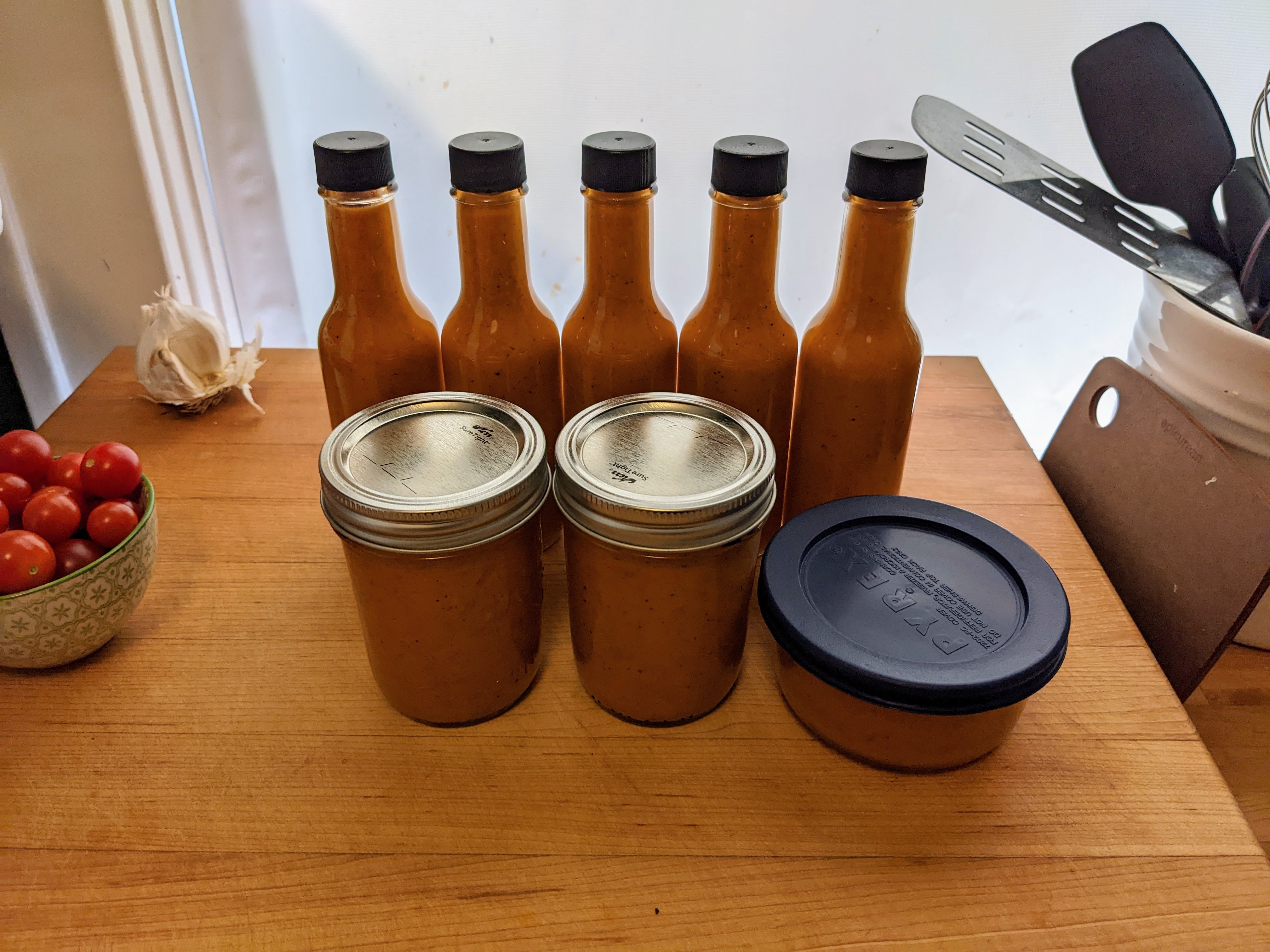 With the first harvest of birds eye peppers, I made a
peri-peri sauce.
This is a sauce that was new to me, but it sounded sooooo good that I had to try it.
It originates from Portuguese + Africa, and is made mostly with charred/roasted
red peppers and tomatoes, gets its heat from African birds eye chillies (peri peri),
and is SUPER citrus forward via lemon and zest. I guess it's often used as a
marinade that can crust up nice on a grill, but can also just be eaten as a
condiment. I did both and shared some bottles with friends and I thought it was great.
I saved one small jar for grilling in springtime. I think there's a lot of room for experimentation with this sauce, so I'm stoked to try it again. I used the late bumper
crop of birds eye to make a sichuan crispy garlic infused peanut oil.
With the first harvest of birds eye peppers, I made a
peri-peri sauce.
This is a sauce that was new to me, but it sounded sooooo good that I had to try it.
It originates from Portuguese + Africa, and is made mostly with charred/roasted
red peppers and tomatoes, gets its heat from African birds eye chillies (peri peri),
and is SUPER citrus forward via lemon and zest. I guess it's often used as a
marinade that can crust up nice on a grill, but can also just be eaten as a
condiment. I did both and shared some bottles with friends and I thought it was great.
I saved one small jar for grilling in springtime. I think there's a lot of room for experimentation with this sauce, so I'm stoked to try it again. I used the late bumper
crop of birds eye to make a sichuan crispy garlic infused peanut oil.
I tried making something spicy, delicious, and more long lived by upping the acidity of a habanero pineapple sauce. I was really happy with the sauce and had so much that I was able to bike it around to gift to friends. I am still eating it here in December....tho it might be a bit tingly, perhaps it's fermenting a bit. :) A bunch of the other habs I dehydrated and turned into power/flake for later sprinkling.
This ghost pepper, though. Sheesh. It was a wildcard to begin with, I suppose, but I took care of it and it grew into a beautiful plant...one that yielded exactly TWO fruit. One of them was pecked (and ruined) by birds (not sure if crow or chicken), and the other one limped along to ripeness at the very end of summer. What do you do with one single stupid Bhut Jolokia? Well, you just eat it, I guess. After lunch one workday I washed, chewed, and ate the ghost pepper. Even as someone pretty well versed in the spice, this was pretty hectic. Apparently the ghost pepper can vary, but this tasted like perfume sprayed on soap, and it was a pringley pokey kind of stabby-hot that continued growing in intensity not dimension. It's fine, but do not recommend. I might try and grow them again sometime, but honestly, I don't know what I'd do if it yielded 50+ fruit like the epic habanero did...

Toorcamp is the American hacker camp. Inspired by the Dutch and German hacker camps, it's an outdoor camping festival for hackers of all kinds. Toorcamp has been running every 2 years since 2009, and like everything else, got fucked up by COVID-19 and delayed and delayed and finally made it work again this year. I've been to them all (including the virtual one in 2020), so this was a nice and cathartic reunion for the cabal. This one was again on Orcas island off the peninsula of Washington. It's beautiful up there!
 In prior years, we had hunkered under the DorkbotPDX moniker, as a group
of like-minded nerds hacking on junk and experimenting with art and tech
(our conjoined siblings include The Church of Robotron
and Futel). This year we were "House Of Pong", bastard children
of #503 and loosely thinking about retro tech and analog videogames.
Small and disorganized, or rightly sized and pragmatic. I dunno.
Fucking oppressive zeitgeist -- We made it work anyway, brought way too much gear, surprisingly enough beer, and had an awesome camp.
In prior years, we had hunkered under the DorkbotPDX moniker, as a group
of like-minded nerds hacking on junk and experimenting with art and tech
(our conjoined siblings include The Church of Robotron
and Futel). This year we were "House Of Pong", bastard children
of #503 and loosely thinking about retro tech and analog videogames.
Small and disorganized, or rightly sized and pragmatic. I dunno.
Fucking oppressive zeitgeist -- We made it work anyway, brought way too much gear, surprisingly enough beer, and had an awesome camp.
Jesse and I taught an intro do Pure Data workshop and had a modest turnout. We've done several workshops on Pd over the years but this was the shortest (others were like 3-4 hours?) and the environment was super diy/ragtag (fighting for equipment/support and noisy neighbors and so many things). People were interested and engaged and I liked our demos a lot (props to jmej on the lights!).
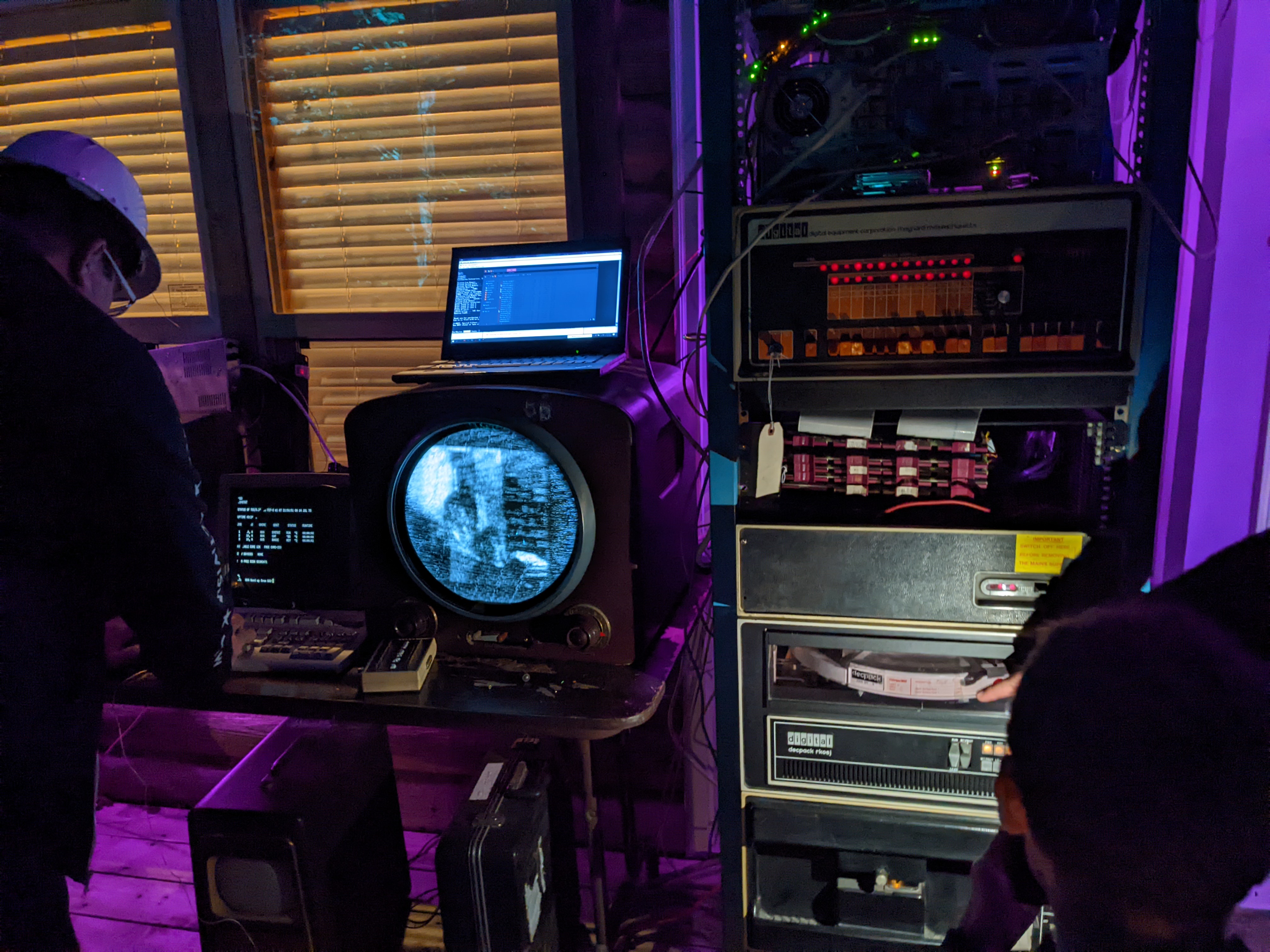 The NightMarket was awesome, and it was fun to play with
ShadyTel's expansion into bullshit currency and payment systems
to foster a fringe-ass economy. It's a travesty that their focus on profit and
status has almost completely shadowed the consumer's ability to actually get
basic service provisioned. We greased palms, we worked the bureaucracy, none of it
mattered, and by the time we got working copper pair service the camp was almost over! Heh.
This really does amplify the importance of competition in the hacker-camp-twisted-pair-phone-service marketplace.
The NightMarket was awesome, and it was fun to play with
ShadyTel's expansion into bullshit currency and payment systems
to foster a fringe-ass economy. It's a travesty that their focus on profit and
status has almost completely shadowed the consumer's ability to actually get
basic service provisioned. We greased palms, we worked the bureaucracy, none of it
mattered, and by the time we got working copper pair service the camp was almost over! Heh.
This really does amplify the importance of competition in the hacker-camp-twisted-pair-phone-service marketplace.
Other memorable points include the amazing computers set up by the Unix Haters group (and an arcade!)...and the Voight/Kampff testing facility, where you might discover if you're a replicant (I'm not telling!). The Psychoholics "Side Quests" was quite well done IMO and they made it both human and fun.
Time distortion has carried over from the COVID-19 quarantine days, so it's still challenging to piece together a sensical timeline. I guess these are the highlights...
My friends Cameron and Molly got married in September. I was lucky enough to join in Cameron's bachelor party, where we did the goofy-yet-fun bicycle barcrawl thing (you know, the big table with pedal seats), hit some karaoke later on. I bought the first suit I've ever owned, and Stacy and I went to the wedding. Those two sure know how to put on a show and have a great time.
In addition to a couple smaller/underground shows, I also saw The Legendary Pink Dots, a unique band that's been doing their thing for a very long time. Edward Ka-Spel still has an amazing voice, and although it'll never be the same without The Silver Man or Niels van Hornblower, I liked the set.
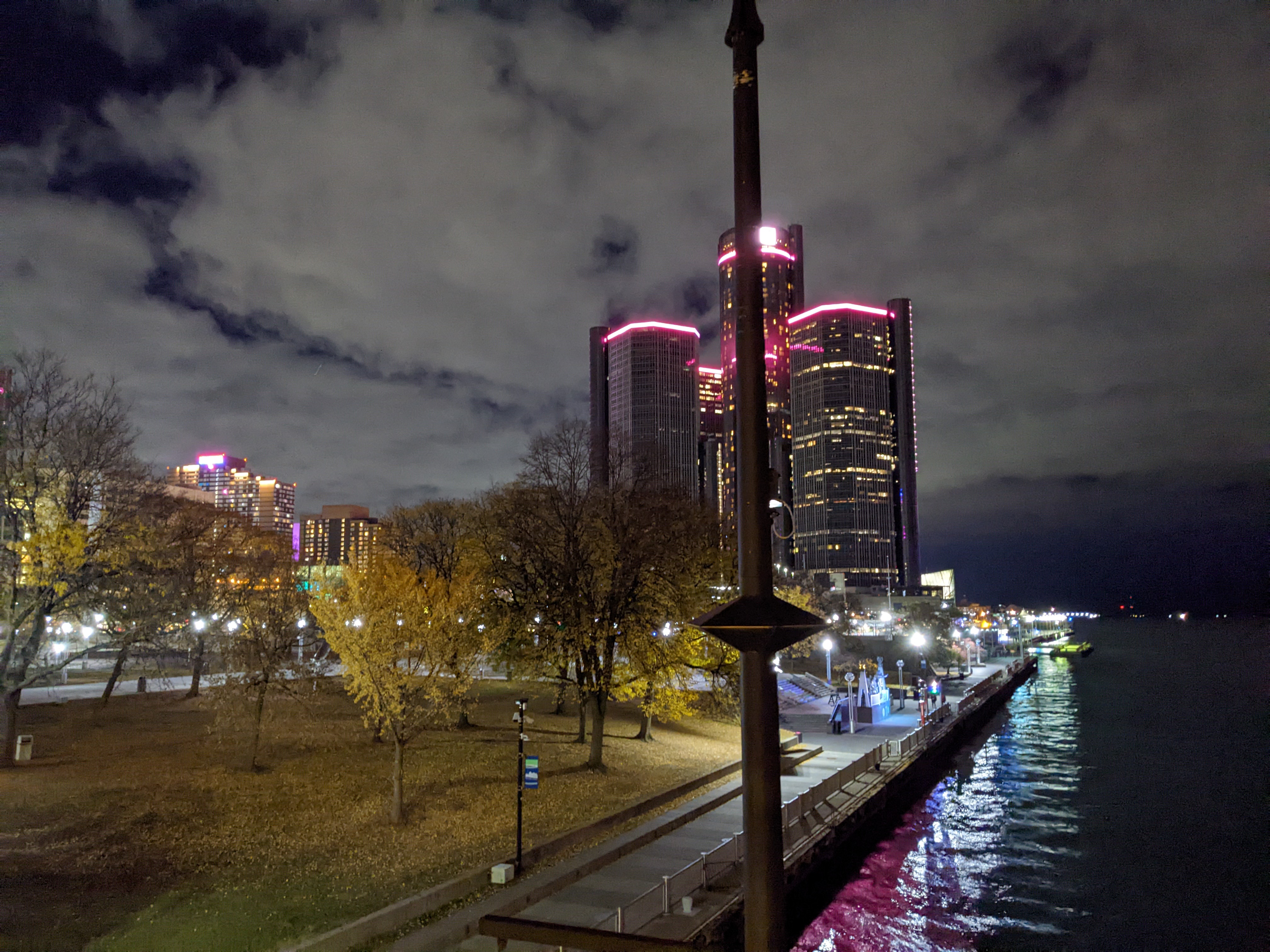 In support of my employer and some work I do with the OpenTelemetry
community, I traveled to Detroit for KubeCon NA and for
OTel Unplugged,
an unconference. It was great meeting several of my work colleagues for the first
time face-to-face, and other folks from the OpenTelemetry world.
It was my first time in Detroit, and it was fun to poke
around the city when not doing work stuff. I ate Detroit style pizza while
in actual Detroit. We walked thru the GM plaza on our
way to the restaurant one night and saw a bunch of concept cars. The riverwalk
downtown was just awesome, looking out across the river south to Canada!
In support of my employer and some work I do with the OpenTelemetry
community, I traveled to Detroit for KubeCon NA and for
OTel Unplugged,
an unconference. It was great meeting several of my work colleagues for the first
time face-to-face, and other folks from the OpenTelemetry world.
It was my first time in Detroit, and it was fun to poke
around the city when not doing work stuff. I ate Detroit style pizza while
in actual Detroit. We walked thru the GM plaza on our
way to the restaurant one night and saw a bunch of concept cars. The riverwalk
downtown was just awesome, looking out across the river south to Canada!
 My hacker friends put me up for a couple nights after the conference, and they
showed me the real Detroit. We got a Coney (dog) at Duly's Place (apparently
world famous!), visited the
Heidelberg Project and walked through a
graffiti park near their neighborhood. For dinner, we hit a taqueria
in the Mexican part of town and the food was sooooo goooood. Some board games,
homemade schnitzel, and time in the hot tub just to round things off! Thanks!
My hacker friends put me up for a couple nights after the conference, and they
showed me the real Detroit. We got a Coney (dog) at Duly's Place (apparently
world famous!), visited the
Heidelberg Project and walked through a
graffiti park near their neighborhood. For dinner, we hit a taqueria
in the Mexican part of town and the food was sooooo goooood. Some board games,
homemade schnitzel, and time in the hot tub just to round things off! Thanks!
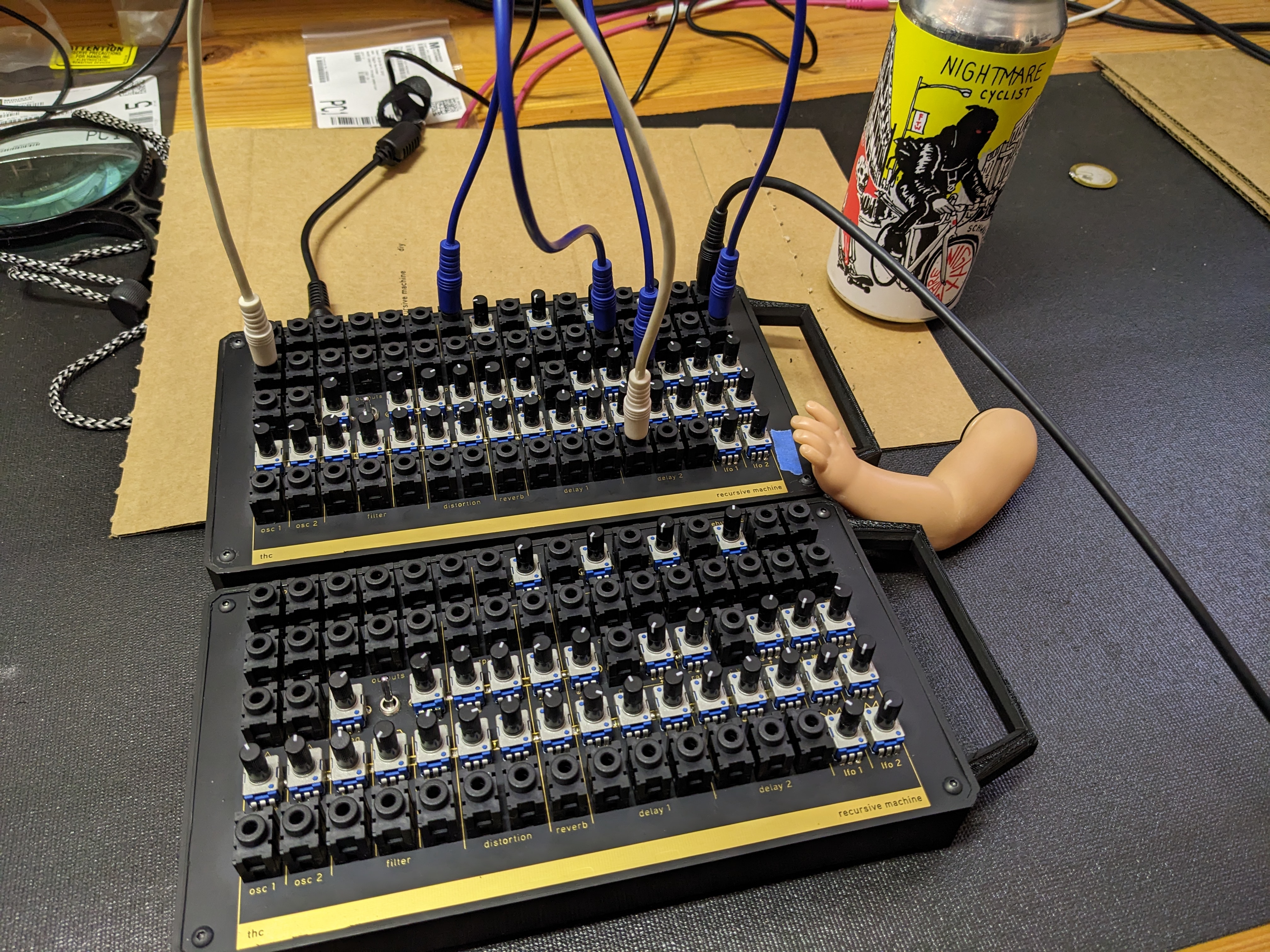 Jesse and I sourced the boards, parts, and enclosures to build and assemble
this patchable drone synthesizer called
The Recursive Machine. This is a patchable
synth by The Human Comparator (THC), a Swedish designer. What's pretty great
about the Recursive Machine is that it sounds great out of the box with
no patches, due to its internal default routing. It's "recursive" in that it has
many layers of feedback paths, to give it a really deep/rich drone sound through
the filter, distortion, reverb, delays, etc. It took several nights of soldering to
complete the build, and then a couple more to troubleshoot and discover that some
ICs I bought from China (on eBay) were counterfeits and don't work. Ugh. Fixed that up
and now it sounds great! It was a challenge to mount the boards in the case, the fit
is way way too tight (tolerances should be dramatically increased). I've spent a
little time playing it, and look forward to using it more next year!
Jesse and I sourced the boards, parts, and enclosures to build and assemble
this patchable drone synthesizer called
The Recursive Machine. This is a patchable
synth by The Human Comparator (THC), a Swedish designer. What's pretty great
about the Recursive Machine is that it sounds great out of the box with
no patches, due to its internal default routing. It's "recursive" in that it has
many layers of feedback paths, to give it a really deep/rich drone sound through
the filter, distortion, reverb, delays, etc. It took several nights of soldering to
complete the build, and then a couple more to troubleshoot and discover that some
ICs I bought from China (on eBay) were counterfeits and don't work. Ugh. Fixed that up
and now it sounds great! It was a challenge to mount the boards in the case, the fit
is way way too tight (tolerances should be dramatically increased). I've spent a
little time playing it, and look forward to using it more next year!
And then below I blogged about taking part in Inktober, a friendly challenge to create an ink drawing based on a prompt for every day of October. It was nice getting back into sketching, and I'm looking forward to doing more of that in my free time (hah!).
We spent Stacy's birthday at a lovely cabin in Rhododendron, OR. It was very peaceful and we feasted and played board games and card games and read books. There was snow on the ground, but it was comfortable to hike in, so I took a nice long walk and made a 1 hour field recording (which I haven't yet released).
During the holiday break, I studied up and got my technician class ham radio license. I was required to get one as part of my college studies, but I let it lapse long ago.
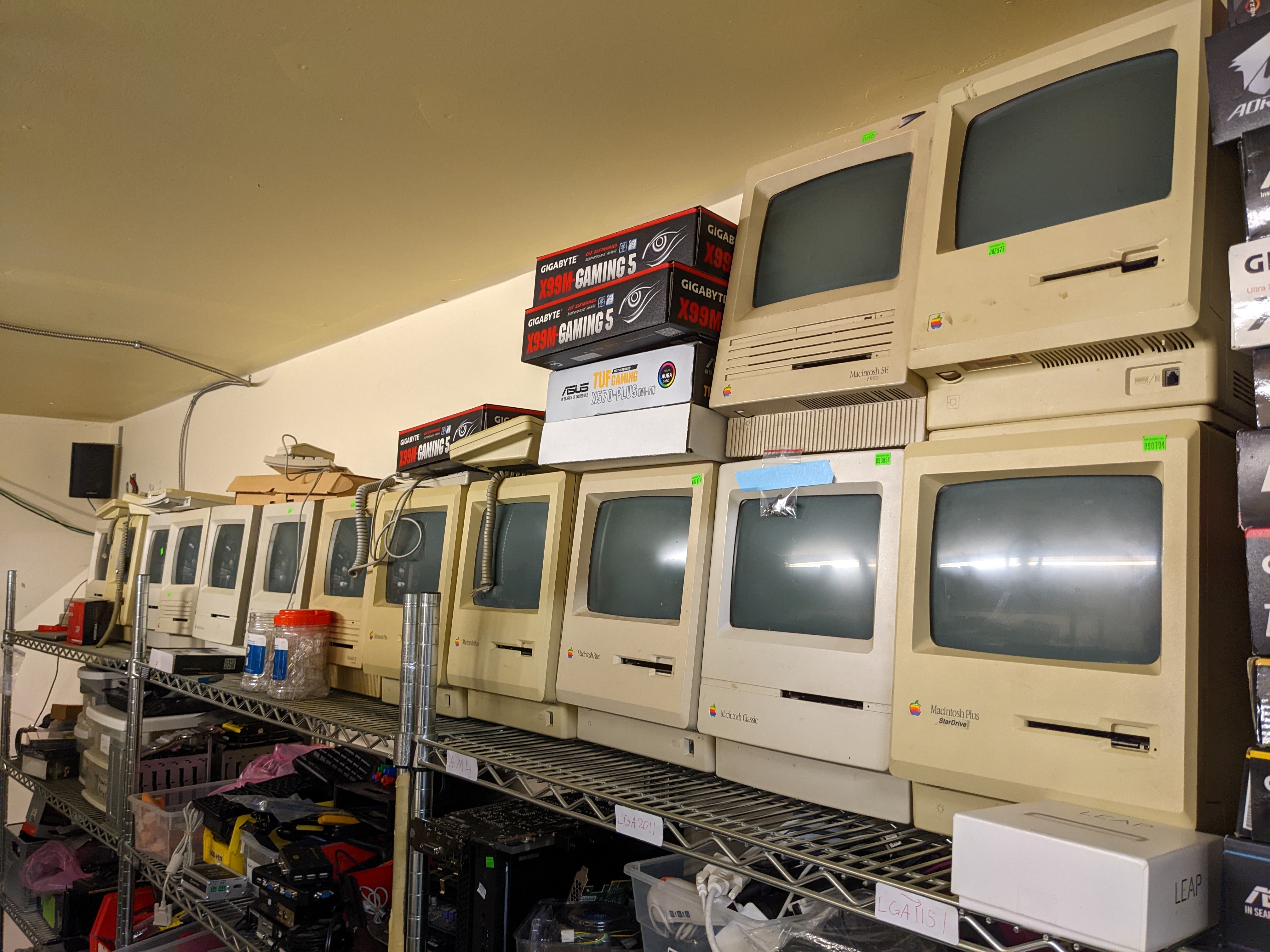 Something I never did when I was younger, that I find joy in now, is
volunteering. It's really been rewarding to put a little bit of myself
into projects that benefit a larger cause.
Something I never did when I was younger, that I find joy in now, is
volunteering. It's really been rewarding to put a little bit of myself
into projects that benefit a larger cause.
I've been working with Futel for several years now, and this year was awesome. We installed a couple new public payphones in Portland, we helped to decommission deprecated hardware in the field, and I continued sometimes hacking on the usage software. It's not great, but it's improved slightly this year and I am looking forward to continuing making it better next year. We also helped expand the reach with a silly Futel themed Pedalpalooza ride.
In addition to supporting the Community Cycling Center with donations, I also volunteered time to walk around and sell 50/50 raffle tickets at a Blazers game. This was at an odd time when people were just barely starting to get back into public events, but it was definitely not full swing, and it was honestly a little hard to sell people on raffle tickets while masked. We had a decent night, and though I forget the final number, we did raise a good chunk of money for a good cause. I also brought together a crew to participate in the scavenger hunt, all for the benefit of the CCC.
Using volunteer days through work, I organized a day of removing invasive ivy from a Forest Park trailhead. I think I managed to get got 5 or 6 of my (remote) colleagues to show up in person too get messy and work their arms pulling this gnarly ivy. English ivy is everywhere, and although it seems overwhelming, every little bit helps, and it's fun to be outdoors making the park a nicer place. By the time we finished that day, it was VERY noticeable how much of an improvement we had made.
I also brought colleagues in Portland together to volunteer at Free Geek, a nonprofit that specializes in recycling and equitable repurposing of technology. In addition to keeping tech junk out of landfills, they also build inclusive education programs and have excellent community support. Again, I think I got maybe 5 or 6 colleagues out for a day of volunteering, which took various forms (for example, I tested and categorized a shitton of HDMI switch boxes). I was particularly impressed by FreeGeek's secure data handling protocols and how serious they treat customer data privacy.
Anyway, that's it for 2022...it's been a good one. See you in 2023!
Tue Nov 08 2022 19:00:00 GMT-0800 (Pacific Standard Time)
Just a short update. I took part in Inktober this year. What's Inktober? A loosely organized effort to get people to practice their ink drawing skills. So there's a predefined prompt every day, and every day you do a drawing based on that prompt.
Here is a link to my 31 drawings.
It was fun getting back into drawing...I really hadn't done much of it in the last 20 years. I'm my own biggest critic, but I'm happy with how many of them turned out. And I appreciated the chance to try some new things and improve some technique.
Looking forward to doing it again next year!
Sun Sep 11 2022 21:08:54 GMT-0700 (Pacific Daylight Time)
I took advantage of the miserable climate change situation to grow some hot peppers this summer. I grew 5 kinds of peppers, just planted from young starts into pots around the beginning of summertime. The ghost pepper (bhut jolokia) plant was quite a failure (only 2 fruit on the entire healthy plant, which don't seem to want to ripen yet), but the rest did quite well...especially since I'm such a novice and I've only grown peppers maybe once or twice before.
First up, a very modest and reasonable harvest of serrano chili peppers. I have been picking a pepper here and there not sure what yet to do with these, other than throw them randomly into foods. Finally decided to make some hot sauce!
Here's the first main harvest, along with some additional ingredients for the sauce (water/vinegar/salt/spices not shown):
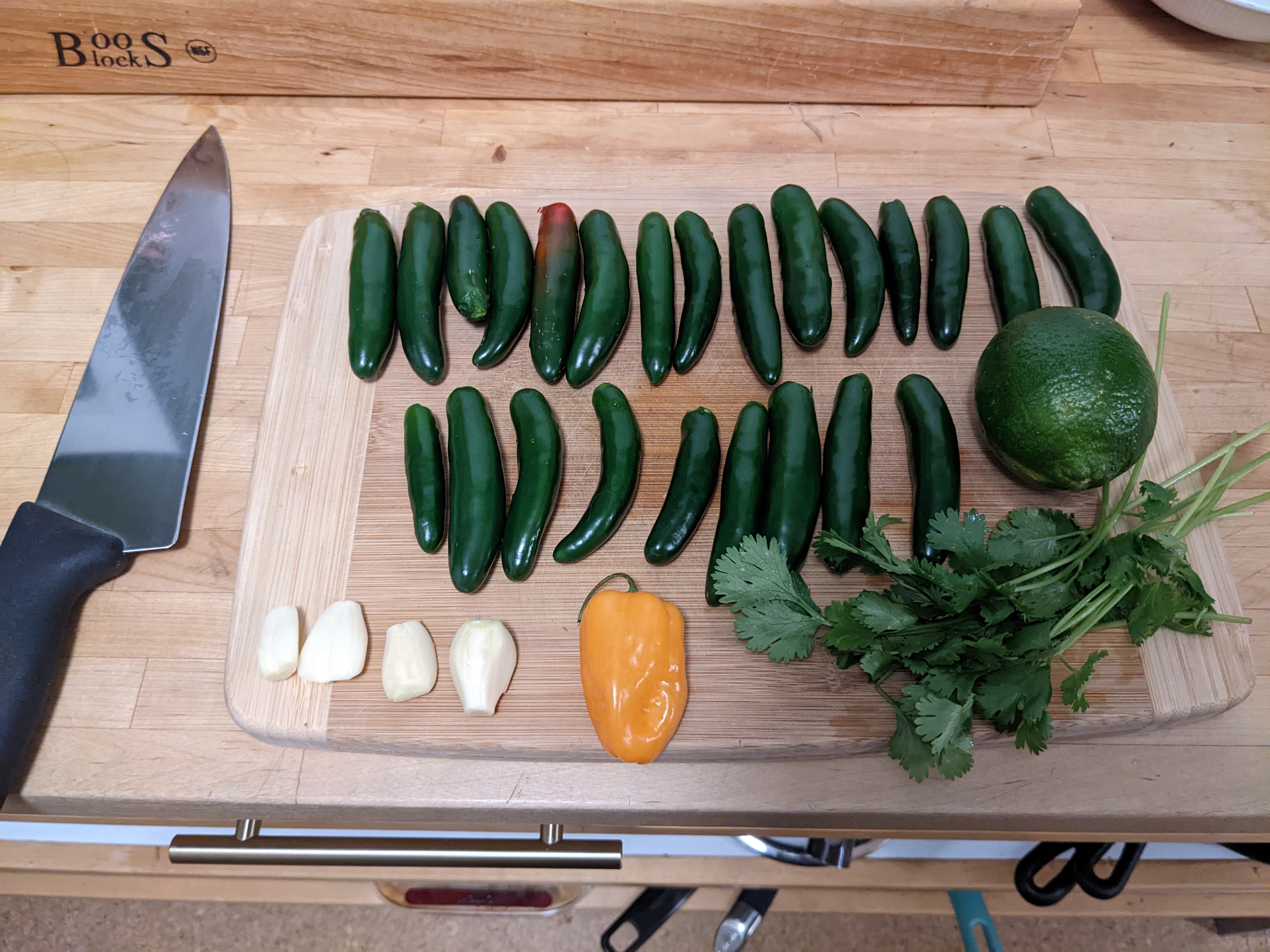
There are still maybe 5-10 smaller/younger viable peppers on the plant that I'll wait a bit longer to harvest.
The mostly followed this recipe but I quadrupled the garlic and I used half an onion instead of a quarter and I used Italian oregano because we didn't have Mexican oregano on hand (I know, I'm sorry, I am a monster). This is a vinegar-based sauce, but I'm not sure the pH is high enough for long term storage.
I bought a case of "woozy bottles" locally from FH Steinbart in Portland and managed to make just under 3 bottles.

I'm quite happy with how this turned out. The taste is flavorful... and hot! Next up will either be a peri peri sauce from the birds eye chilies I grew, or one or two types of habanero sauce. Stoked!